
My Bitcoin Journey 🧑🏾💻

Over the next few weeks, I will be re-publishing some of my previous writing on my substack so that any new subscribers or followers have an opportunity to read old articles.
With cryptocurrencies currently in a downturn from recent highs (alongside the wider stock market), I thought it relevant to share an article titled ‘My Bitcoin Journey’. Originally published in July of last year when Bitcoin was hovering around $30,000, the cryptocurrency has dropped to around $40,000 after rallying to $69,000 last November.
The article is a 10 minute read and covers my personal journey in Bitcoin and why I believe in the potential of cryptocurrencies in the long term.
My Bitcoin Journey 🧑🏾💻
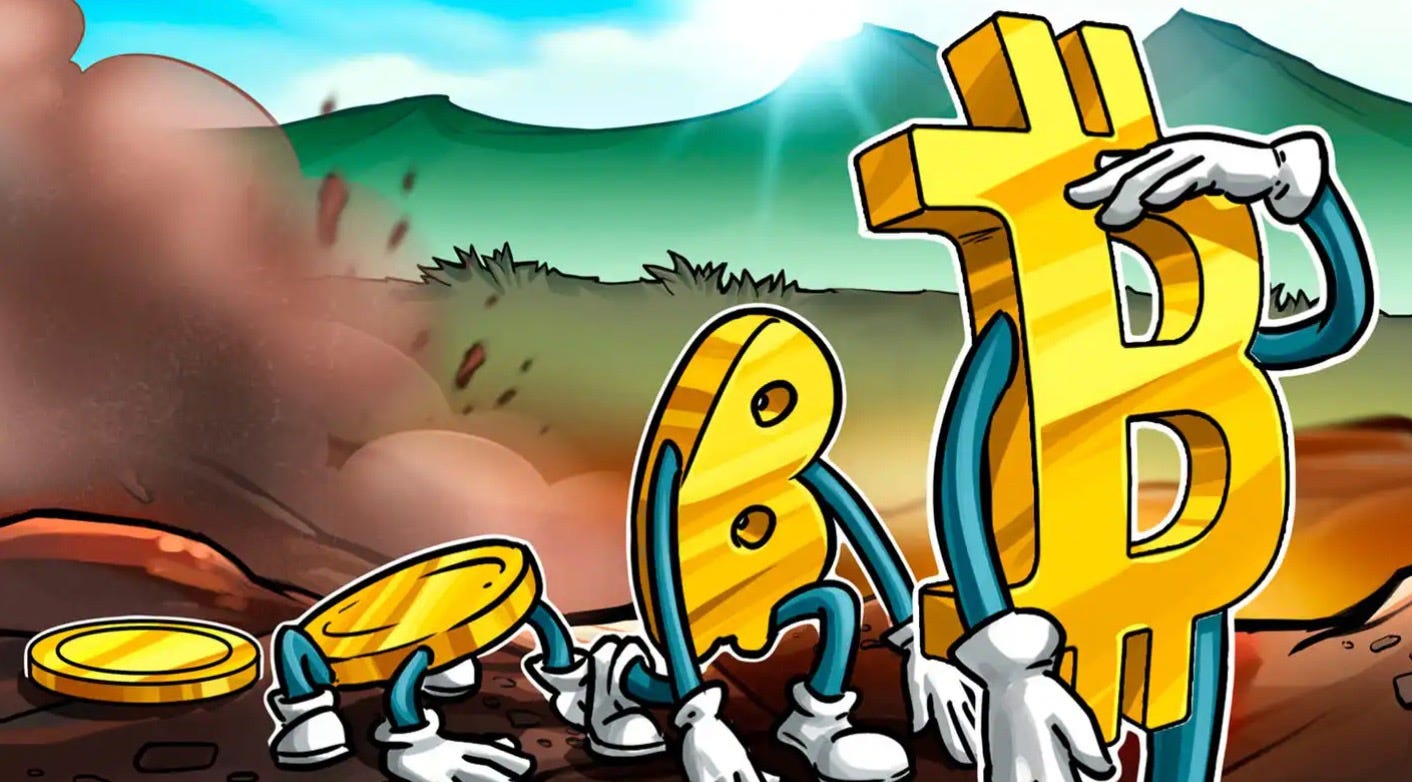
Cryptocurrencies can feel like an enigma. You may have been debating investing in the likes of Bitcoin and Ethereum because their recent returns have captured public attention and let’s face it, who doesn’t want to invest in something that will make them money?
However, the stories you’ve heard of people losing all their money in lesser-known cryptocurrencies such as Safemoon have you scratching your head and thinking “I’ll just wait this one out.”
In this article, I will cover my own journey in the cryptocurrencies and outline their potential as an investment asset so that you can make an informed decision on whether investing in them is for you.
Introduction ✍🏽
I first heard of Bitcoin when I was at university in 2012. It was labelled the “currency of the future” as it allowed the transacting for goods and services on the internet without having to provide any credit card details / banking information.
It intrigued me and I’m sure I made a half attempt at trying to buy some late one night, but being a student, I had more pressing matters on my mind, such as making sure I didn’t oversleep for another lecture the following morning.
I recall discussing Bitcoin with friends and colleagues occasionally in the years after, but it was never in a serious manner. One message in a group chat mentions telling a friend I will pay them in Bitcoin as a joke. I’m pretty sure they’re wishing I had actually done that now!
I think part of the issue was that I did not really understand investing. I had the impression that investing was for the rich and wealthy and inaccessible to the average person. After starting my graduate job, my main aim was to just build up some funds for a rainy day.
However, in the early summer of 2017, I began to realise that saving alone would not make me wealthy. I started researching investing and trading and not understanding the power of compounding returns, I wanted to try my hand at making some money quickly. I had seen the movies; how hard could it be?
Having limited knowledge on the dangers of trading, I ended up losing most of my savings at the time day trading oil. Anyone who tells you day trading can be picked up easily is lying to you. It’s the riskiest form of investing and typically more than 90% of day traders lose money.
There is a big difference between day trading and long-term investing. Anyone can start investing but you need to have years of experience and knowledge to day trade effectively.
The Crypto Summer 😎
Luckily, it was around then that I rediscovered Bitcoin alongside Ethereum. The price of one Bitcoin at the time was $2,500 with the price of one Ethereum being $200.
I’m not going to lie to you and tell you that it was the technology and vision of cryptocurrencies that attracted me to the space at the time. No, it was the fact that Ethereum had risen 20x in 6 months and Bitcoin itself was garnering attention in mainstream media as it had eclipsed the value of an ounce of Gold for the first time.
After hesitating at first, I took the rest of my savings (which wasn’t a lot after my day trading debacle) and invested into Bitcoin and Ethereum. It is often said that the quickest way to learn how to invest is to put your money on the line and I could not agree more with this statement.
With most of my liquid capital invested, I started looking into the value proposition of cryptocurrencies in the following months. The more I read, the more I started to believe in their long-term potential to reshape our global financial systems.
Bitcoin was created in 2009 by Satoshi Nakamoto (a pseudonym) in the aftermath of the 2008 financial crises. The technology that underpinned it, the Blockchain, solved the Byzantine General’s Problem. This had plagued the transfer of money and information for thousands of years. In short, a trusted third party was required in almost all cases to verify transactions or the validity of information / statements. You can learn more about the Byzantine General’s Problem here.
Our modern financial and political systems are centralised with power held at the helms of companies, banks and governments. These “trusted” middlemen hold the keys but the majority of us have limited influence if they decide to cut or restrict our access to the system.
For the first time in history, a currency had been created that allowed anyone with an internet connection to move value anywhere in the world without the need to seek permission or get verification from any middlemen. You can hold these assets, use them as a store of value or medium of exchange and no one can take them away from you (as long as you hold them in a hardware crypto wallet).
Furthermore, most cryptocurrencies are decentralised by nature. This means that they cannot be controlled or influenced by single organisations or individuals and are built on the power of the community.
During the last couple of months of 2017 and into early 2018, both Bitcoin and Ethereum staged meteoric rises. The price of one Bitcoin at one point reached almost $20,000 with Ethereum reaching over $1,300 at its peak.
I was on holiday in Thailand in December 2017 watching the value of my combined investments increase more than 5-6x in a matter of months. I recall having dinner on the beach on Christmas Day with an amazing view of the sunset sipping on a cold drink thinking “Wow, my whole holiday is paid for.”

The Crypto Winter 🥶
Of course, it didn’t quite work out like that. I didn’t sell any of my holdings because I thought the prices would continue to rise. They didn’t.
In the first few months of 2018, the whole of the crypto market crashed and this continued for the rest of the year with Bitcoin dropping as low as $3,000 around Christmas 2018, only a year after it had touched $20,000.
Apart from a brief short-lived bullish period in the summer of 2019 that sent prices above $10,000 again, the price of Bitcoin didn’t do much for the rest of that year and never approached anywhere near its all-time highs of 2017. It didn’t get much better in 2020 as the initial world ending panic caused by the coronavirus pandemic sent Bitcoin crashing below $4,000
Despite the prolonged downturn in prices during 2018, 2019 and the first half of 2020, I held the majority of my holdings and didn’t sell. The risks I had navigated by investing in Bitcoin and Ethereum also allowed me to research and understand the art of investing in the wider stock market.
Whilst the price action was very negative in those years, the crypto communities were continuously improving the networks and consistently onboarding new use cases. A summary of these use cases such as NFTs and DeFi was covered by the Instagram post below.
Despite my belief in cryptocurrencies, I didn’t place any further investments into the in the years when prices were at all-time lows. I did anticipate that there would be another bull market when their potential was eventually realised. Thus, in October 2020, when the price of Bitcoin was around $10,000 and Ethereum was $400, I took the plunge invested around 10% of my portfolio.
In its response to Covid-19, the US Government printed more than 20% of all US Dollars in circulation in 2020. This oversupply of money in the market reduces the purchasing power of each dollar. In times of crises, investors look to hedge their bets by investing in store of value items such as Gold. Now they also have the option to invest in Bitcoin.
Mainstream Adoption 🌍
In the last few months of 2020, as the world recovered from the pandemic, the crypto market slowly started to come into the spotlight again with the media attention centering around Bitcoin’s properties as a store of value akin to “Digital Gold”.
Prices started rising again and eclipsed the previous all-time highs achieved in 2017. This time it felt different. The same Banking CEO’s that had called Bitcoin a ‘fraud’ a mere three years ago (JPMorgan’s Jamie Dimon), were rushing to make sure that they could service their ultra-wealthy clients with options to invest and predicted that Bitcoin’s price could reach as high as $146,000.
Companies were starting to hold Bitcoin on their balance sheets as an alternative to cash. Paypal started allowing customers to buy, sell, store and use cryptocurrencies for payments. Elon Musk broke the internet when he announced that Tesla had invested into Bitcoin and would start accepting it for payments in February 2021.
The price of Bitcoin reached over $64,000 in April with Ethereum rising to over $4,000 in May. At this point, cryptocurrencies still only comprised 20% of my overall portfolio. Despite believing in the space, my investments had not matched that conviction over the years. I told myself that if another drop in prices presented an opportunity, I would seize it.
That opportunity arose in the middle of May, when Elon Musk stated that Tesla would stop accepting Bitcoin as a payment method (but it would still hold the Bitcoin it had bought) due to concerns around its environmental impact. This has caused a sustained downturn in the prices of all cryptocurrencies over the last few months with Bitcoin staying in the $30-40k range and Ethereum also losing more than half of its value dropping below $2,000 at its lowest.
Future Potential 🔮
This time, I seized the opportunity and took advantage of the reduction in prices to acquire as much as I could. I don’t think many of us understand the power of small consistent investments.
I recalled reading about someone who had invested $50 every week into Bitcoin for over three years from 2018 to 2021 and this strategy allowed them to accumulate almost 2 Bitcoin at an average value of around $7,000 per coin.
Thus, over the last two months, I have rebalanced my holdings significantly so that my cryptocurrency holdings now comprise over 50% of my portfolio and I still aim to invest consistently every week (this is a process knows as Dollar Cost Averaging (DCA), see the this post on Instagram to understand how to use DCA).
Short term price fluctuations do not bother me because I’m in it for the long run. The fundamental value proposition of cryptocurrencies has not changed in these last few months. If anything, it has gotten stronger.
The environmental impact that Elon Musk mentioned is being negated by Bitcoin miners utilising increasing amounts of renewable energy. In fact, over the last few weeks, he went as far to say that he believes Tesla will start accepting Bitcoin for payments again soon.
If you are an emotional investor, I would not recommend allocating most of your portfolio to cryptocurrencies as the price movements are not for everyone. However, if you can manage to live with the volatility in the short term, it is my personal belief that your investments will be rewarded handsomely over the long term.
Cryptocurrencies are gaining considerable traction and adoption around the world, with countries such as El Salvador now accepting Bitcoin as legal tender and a real belief that they can assist in addressing global wealth inequality.
Due to the fundamental properties used to create it, there will only ever be 21 million Bitcoin of which 18.7 million are already in circulation. As time passes, more individuals and institutions will want to own Bitcoin and there will be less of it in the market. Based on the nature of supply and demand, this will increase its value to all participants.
What Bitcoin does a payment network is that it allows anyone in the world with an internet connection to utilise it. It doesn’t care where you were born, what language you speak, what religion you are, your wealth status, your education status. None of it matters. If you have an internet connection, you can plug into this monetary system and you can move value around the world to anyone else without asking for permission.
This utopian message was covered briefly in one of my Instagram posts below by emphasising how three distinct individuals on the different sides of the world all have the same access to Bitcoin and the potential ramifications of this access.
It evens the playing field. It would be impossible for the farmer in Kenya and the Rickshaw driver in India to transact easily in US Dollars without significant oversight and control from their local governments.
With Bitcoin, they can seamlessly transfer value in minutes to anyone, anywhere in the world as long as they have an internet connection.
The Bottom Line 🏁
In conclusion, I hope walking through my Bitcoin journey has been helpful for anyone considering investing in cryptocurrencies. Be prepared for volatility, carry out research, read articles and listen to podcasts so that you can educate yourself on their potential.
Most importantly, as with any investment, only invest funds you don’t need immediate access to and can afford to lose.
The majority of my cryptocurrency holdings are in Bitcoin and Ethereum because they are established and have strong communities around them that continue to innovate.
There is the potential to make life changing returns in some of the lesser-known projects. However, the majority of these are really high risk and can sometimes lose up to 90-95% of their value in a matter of days. For this reason, I avoid them at all costs.
I strongly believe in the power of Bitcoin, Ethereum and other cryptocurrencies to cause a seismic shift in the global financial systems. That is why I have shifted more than 50% of my portfolio to these assets and my plan is to hold them for at least the next 10-20 years.
Nevertheless, I am a big believer in diversification and ensuring you don’t have all your eggs in one basket. That is why the remaining 50% of my portfolio is invested in the stock market in companies that I believe will shape the next few decades.
If you’re new to investing and looking for a place to buy Bitcoin and other cryptocurrencies, eToro is one of the easiest to use platforms for beginners. The key is to stop procrastinating, take the leap and get started today.
Disclaimer: This article covers my personal journey and beliefs around Bitcoin and other cryptocurrencies and should not be taken as financial advice. Please do your own research before making any investment decisions.